
MATCHi product
eco-system
Defining the strategic product direction for a leading racket sports platform, focusing on player experience, venue tools, and platform scalability.
Main goals
→ Create a unified product vision that aligns player needs, venue experience, business goals, and platform scalability into a cohesive roadmap for 2023.
→ Define strategic initiatives with clear value propositions for all stakeholders: players, venues, and MATCHi, to drive engagement, retention, and revenue growth.
Client
MATCHi
Project type
Product strategy, Business Design, Concept design
My role
Design leader, Product Design Lead
Main activities
Strategic planning, stakeholder alignment, concept design, roadmap creation, presentation delivery
Deliverables
Product roadmap presentation, concept mockups, strategic initiative briefs, stakeholder presentations
🎯
Player engagement
Drive social features to increase bookings and retention
🏢
Venue growth
Enable venues to attract and retain more players as increase loyalty
💳
Payment modernization
New payment options to increase conversion via MATCHi touch-points
🔗
Platform unification
One core MATCHi platform across all products to enable cross portfolio alignment
The challenge
MATCHi needed a clear product roadmap for 2023 that would align the entire organization around strategic priorities. As a growing racket sports platform, the company needed to balance the needs of players seeking social sports experiences with venues requiring powerful business tools.
The challenge was to create a cohesive vision that addressed three key areas: enhancing the player experience to drive engagement, empowering venues with better membership and payment tools, and building a scalable platform that could support future growth and integrations.
Strategy pillars
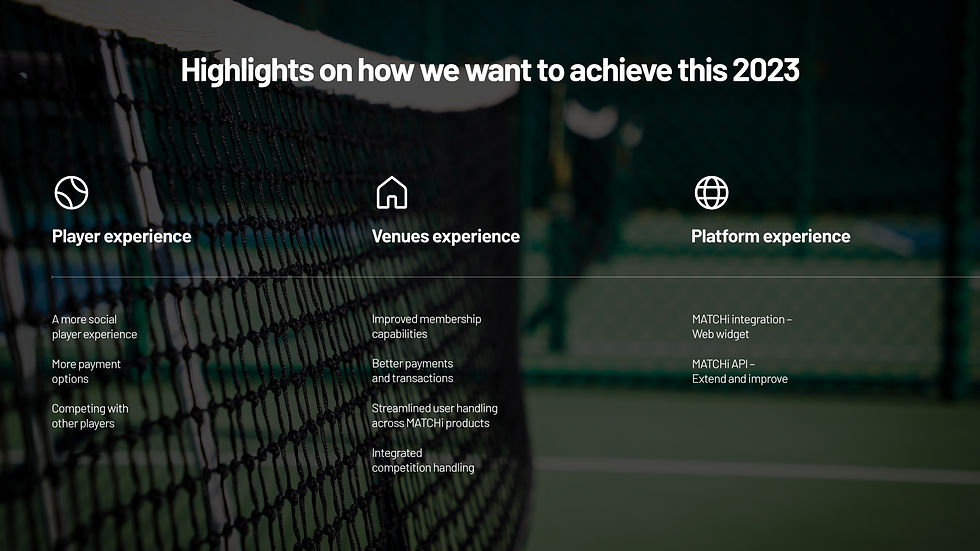
The roadmap was structured around MATCHi's three strategic pillars: Core, Padel, and Platform. Mapping initiatives across three experience tracks: Player, Venues, and Platform. Each initiative was evaluated against user needs, stakeholder value and business ROI. Deliverables included concept mockups, strategic briefs, and a comprehensive presentation.

Road map approach
Collecting the products in the MATCHi portfolio and aligning the main stakeholders and contributors on one strategic vision. This included closely collaboration with CPO, CCO, PMs, Designers and tech people. The main goal was to unify the experience and the company on one common and over-arching strategy.
For each initiative, we documented not just what we would build, but why it matters. Every feature was evaluated against three questions:
-
Why is this important for users?
-
What's in it for venues?
-
What's the ROI for MATCHi?
The roadmap was structured into Now, Next, and Later phases to provide clarity on priorities while maintaining flexibility. Detailed concept designs and mockups accompanied each initiative to align stakeholders and development teams.


Key focus areas
Player experience
→ Players want to plan and book matches together. Competitors have similar social experiences that create engagement and retention. For players, this enables them to plan, book, and play more matches via MATCHi touch-points.
→ Players want more payment options. This is common feedback from venues and their player communities. Modern payment methods are important to enter new markets and ensure players pay for bookings inside the MATCHi ecosystem.
Venues want growth and loyalty
→ Venues need better tools to target and differentiate their members. They want to attract players and build loyalty over time with tailored promotions for different member types.
→ Venues need streamlined user handling across MATCHi products to better service their players and efficiently manage their communities.
Platform opportunities
→ One MATCHi user profile across all products would increase conversion of new users and enable users to access any product in the ecosystem with one account.
→ Integrated competition handling connecting MATCHi app with Padelboard would build a common user base and generate more activities and bookings.

Overview of strategic road map
Each product area and experiences was broken down in to strategic intents and alignment as well presented with examples and suggested concepts




Defining expected outcomes
"
"Finally MATCHi make it easier to book, play and socialise with my racket sports friends in one place."
"
Strategic initiatives summary
Player experience
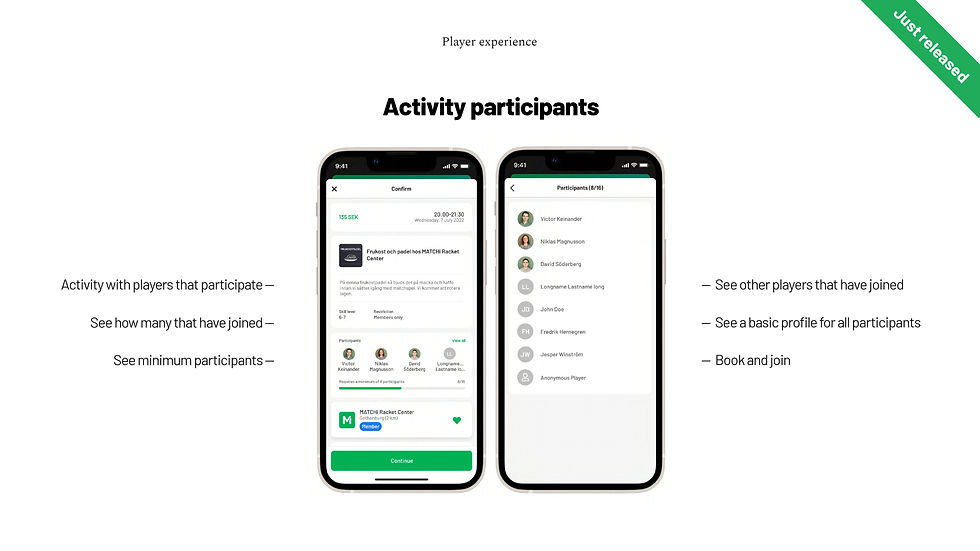
→ Public player profiles, shared booking sessions, open matches, and activity participants to create a more social MATCHi
→ New payment solution via Adyen with more payment methods, promo codes, gift cards, and split payment options
→ Integrated competition experience with tournament activities in MATCHi app and Padelboard connection
Venues experience
→ Dynamic membership types (Gold, Silver, Bronze) with different price lists and members-only bookings
→ Streamlined user handling with one unified MATCHi user profile and new sign-in themes
→ New checkout experience across the portfolio enabling modern payment methods
Platform experience
→ MATCHi web widget integration for venues to embed booking on their own sites
→ Extended and improved MATCHi API for partner integrations
→ Integrated competition handling across all MATCHi products
The impact
The roadmap provided a clear strategic direction that aligned product, design, and engineering teams around shared goals. It articulated the value of each initiative for all stakeholders – players, venues, and MATCHi itself – making prioritization decisions transparent and defensible.
By connecting product decisions to business outcomes and user needs, the roadmap helped prioritize investments and communicate the product vision across the organization and to external partners.


Key learnings
Creating a product roadmap for a multi-sided platform requires balancing the needs of different user groups. Players want social features and convenience, while venues need business tools and flexibility. The key is finding initiatives that benefit both.
Framing each initiative with clear value propositions for all stakeholders – users, customers, and the business – creates alignment and makes prioritization decisions more transparent and defensible.
Design concepts
Making it visual
We continued the project by moving on from discovery in to the define and design phase with a clear problem definition. In this phase we evolved and explored different solutions as well as design into the final solution.


